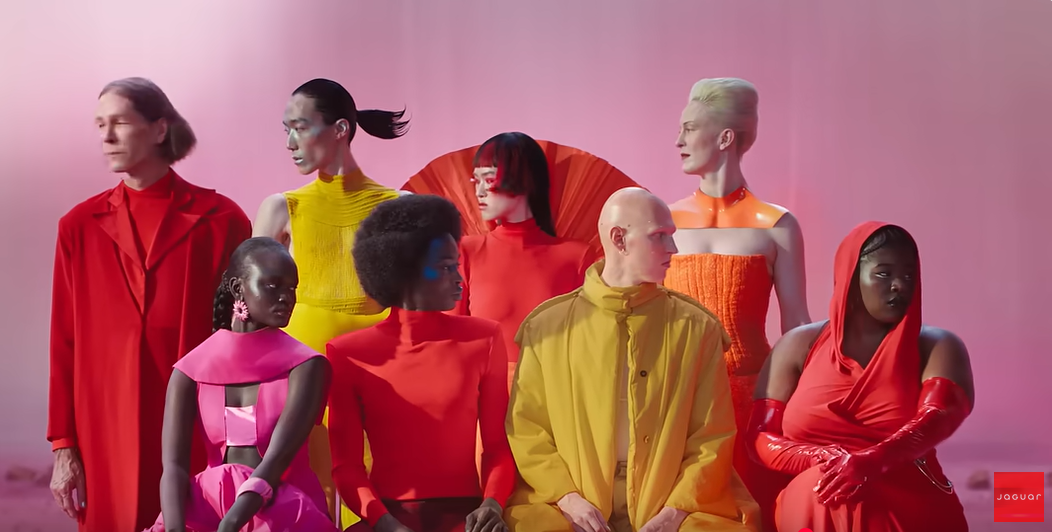
On November 18, 2024, Jaguar Land Rover, the British sports car and luxury automobile brand, launched an advertising campaign for their Jaguar line of cars as part of a rebranding effort that featured a short video released on various social media platforms. The video faced immediate criticism from the public on YouTube, Facebook, X, and Instagram, where people expressed confusion and frustration with the video’s vague concept, tone, and unfamiliar avant-garde approach. JLR announced their new communication strategy “Reimagine,” on their website as a business transformation to become carbon net zero across their supply chain, products, and operations by 2039, and for Jaguar to be entirely electric by 2030.
The video advertisement is presented more like a fashion ad than a car commercial and includes several human models dressed in lavish clothing and vibrant colors. There are no cars featured in the advertisement, only the models against a futuristic background with one model holding a paintbrush and another shown with a sledgehammer. The ad is edited to the pace of electronic background music and incorporates the phrases, “Create Exuberant,” “Live Vivid,” “Delete Ordinary,” “Break Moulds,” and “Copy Nothing.” The ad was created by Jaguar’s internal creative team rather than an external advertising agency. Two weeks after the video was released, Chief Creative Officer, Gerry McGovern, unveiled the new design concept for the Jaguar Type 00 car at Miami Art Week and doubled down on support for the new ad campaign and used a phrase from the video in a statement to the audience, “Be brave, be fearless, copy nothing.” During the presentation, he recalls a brief he had given to his creative team and having told them, “Create new objects of desire,” which he then boasts to the audience, were his exact words.
The presentation was posted on Jaguar’s YouTube channel and received similar comments as the initial video advertisement, with people mocking McGovern and Jaguar, and calling for the removal of JLR leadership. Comments expressed anger and confusion about the vagueness of the message and failure to connect with existing customers. Comments from existing customers express frustration with the unfamiliar tone of the ad and failure to connect with previous generations. Other comments cite the long history of Jaguar as a global brand and how it is no longer recognizable, including the iconic logo that has been replaced with a monogram and the letters, “J” and “R.”
The sudden outpouring of negative e-WOM and complaint-focused comments contributed to an online firestorm (KIM, S. et al., 2025), which has since developed into a reputational crisis due to the online backlash against the company’s decision to rebrand Jaguar. In addition, the criticism can be attributed to JLR’s perceived disregard for customer feedback, and refusal to communicate a clear and effective message more aligned with longtime stakeholders and loyal audience (Langaro, et al., 2022). Rather than apologize or take corrective action following the release of the video, Jaguar continues to defend their campaign, as is evident in their response to negative comments on social media. In a response to Elon Musk, who commented on the video, “Do you sell cars?” Jaguar replied, “Yes. We’d love to show you. Join us for a cuppa in Miami on 2nd December? Warmest regards, Jaguar.” In response to a similar comment asking if Jaguar is a car company or something else, Jaguar replies, “Soon you’ll see things our way.”
There are thousands of comments to the ad video on social media including 21k comments on Facebook, 123k on X, 64k on Instagram, 45k on YouTube, and millions of views ranging from 1.3M on Facebook to 8.5M on Instagram. Jaguar’s replies to comments are dismissive and emphasize the new direction of the brand, such as, “The story is unfolding. Stay tuned.” and “This marks a shift in our thinking, a step towards a new creative philosophy. Rest assured, more will follow.” The disconnect with company stakeholders continues to grow since the initial release of the video and following McGovern’s presentation at Miami Art Week, however, the company has not shifted from its apparent communication strategy and continues to distance itself from their traditional identity.
It is not uncommon for corporations to change their visual identity, such as with Facebook, now Meta, and with Coca-Cola away from its script logo to a more basic typeface. Some of the reasons for the change include a reflection in a new corporate strategy, a merger or acquisition, a change of corporate identity, a need to build a new positive image or desire to modernize or rejuvenate the organizational appearance (Bolhuis, W., et al., 2018). According to financial statements and articles, Jaguar vehicle sales have been in decline since before the pandemic and the company is ending production on all current models. Although the new electric models will not be available until 2026, the latest communication strategy, Reimagine, appears an attempt to create interest and modernize the Jaguar brand. The modernization of the Jaguar brand is reflected in the online ad video, and while the ad has created interest and curiosity around the transformation, it has come at the expense of preexisting customers and longtime supporters. The reaction to the ad has had an overwhelming negative response, and even though JLR appears unphased, they would benefit from salvaging their reputation and loyal customer base who have been supportive of the brand’s heritage.

According to Social Mediated Crisis Communication (SMCC), the primary audiences involved in the reputation crisis of Jaguar were followers on their own social media platforms who reacted to the video. The large number of existing followers and Jaguar’s self-promotion of the advertisement more than likely contributed to the increase of external traffic and users with no personal connection who were looking to engage with other users. In addition, journalists, bloggers, and influencers, especially in the marketing and auto industry, helped shape public perception around the negative response to the video in numerous articles, podcasts, digital and traditional news stories. Inactive users on the platforms who consume information and participated in comment threads, despite not engaging with other online users, also contributed to the crisis.
Jaguar was quick with their response to negative comments on their social channels, but should have used a more empathetic voice, understanding the emotional connection of their followers with the history of the brand. Instead, Jaguar continued to use a tone that was unapologetic, rather than take a conversational approach. Because of this, they not only lost their connection with preexisting followers, but missed an opportunity to reach a new audience and address some of the more meaningful discussions resulting from the ad that centered on diversity and inclusion. Most of the comments from Jaguar on social media focused on corporate campaign slogans, which worked to project the message of transformation and modernization, but without the intended emotional response, leading to frustrated and confused followers.
Moving forward, Jaguar management has not avoided the spotlight, and they continue to provide interviews and presentations of the new vehicle, including at Paris Fashion Week, where they debuted the Type 00 in a French Ultramarine color that arrived with Irish actor Barry Keoghan. Images of Keoghan and the Type 00 from the March 10 event in Paris have been posted to Instagram, and later posts in March show images of actress Zoe Saldaña with the Type 00 at the same event. Other than these images and a few sporadic posts of the new vehicle design on Instagram in February and January, messaging on other Jaguar social media channels has been non-existent since December 3. Management has been forthcoming in defense of the Reimagine campaign in interviews and on the JLR and Jaguar websites, but they have not yet taken full advantage of their own social media channels where they have access to their own creative team, a strong following, and full control over their message.
Although the reaction to the images on Instagram remain mostly negative, there has been a noticeable increase in positive comments, including with communication surrounding DEI, which is a significant part of the Reimagine campaign according to the JLR website. This has created a divide between the new generation of Jaguar followers and the perceived image of the previous generation of followers, as is visible in online comments and interviews from management. Since the release of the ad in November, the company appears to have now taken a more selective approach with how it responds to users on social media. There have been far less replies to comments that seem to have a disruptive purpose, and more replies to comments that offer more favorable outcomes. Rather than communicate with trolls as they did in November following the video post, they have allowed more space for interaction about the product, and less disruption in the comment thread.
Where Jaguar can make drastic improvements is with the use of testimonial-type content from people who support the brand while also finding ways to connect the past with the present. There remain many followers who are confused about Jaguar’s new communication strategy and have expressed feelings of abandonment or alienation following the removal of familiar design elements. The company should offer clearer insight that is consistent across all social media channels about the Jaguar brand transformation and what the public can expect from the Reimagine campaign and the company in the future.
References
KIM, S. et al. Online firestorms in social media: Comparative research between China Weibo and USA Twitter. Public Relations Review, [s. l.], v. 47, n. 1, p. N.PAG, 2021. DOI 10.1016/j.pubrev.2021.102010. 6 abr. 2025.
Rost K, Stahel L, Frey BS (2016) Digital Social Norm Enforcement: Online Firestorms in
Social Media. PLoS ONE 11(6): e0155923. doi:10.1371/journal.pone.0155923
Langaro, Daniela & Loureiro, Sandra & Schivinski, Bruno & Neves, Helder. (2022). In the eye of the (fire)storm: better safe or sorry? Crisis communication strategies for managing virality of online negative brand-related content. Journal of Marketing Communications. 1-17. 10.1080/13527266.2022.2109056.
Bolhuis, W.; De Jong, M. D. T.; Van Den Bosch, A. L. M. Corporate rebranding: effects of corporate visual identity changes on employees and consumers. Journal of Marketing Communications, [s. l.], v. 24, n. 1, p. 3–16, 2018. DOI 10.1080/13527266.2015.1067244.
 The Hankshire